
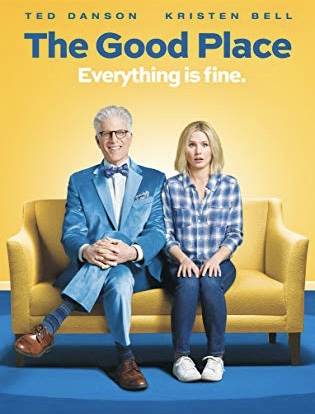
OF COURSE I watched The Good Place when it first aired in 2016. There was no way I couldn’t. With Kristen Bell and Ted Danson as central characters, how could it go wrong? Kristen Bell charmed me as the sassy and fearless girl detective on Veronica Mars in 2004 and continued to impress when she made a turn toward comedy, starring alongside Jamie Lee Curtis and Sigourney Weaver in the underrated rom-com, You Again, making guest appearances as Leslie Pope’s recurring foe on Parks & Recreation, and scoring leading roles in hits like Bad Moms and A Bad Mom’s Christmas. And who could forget Ted Danson as Sam Malone, the cocky ladies man who bartended for one of wackiest packs ever to grace television in the acclaimed ‘80s sit-com Cheers? He made a few notable appearances on the big screen and then took an interesting turn in the late ‘90s when he emerged as the title character in Becker, an absurdly entertaining comedy about a grouchy, disagreeable doctor who ran a clinic in New York City and tried like hell to hide his benevolent side.
So The Good Place was sure to be a hit. And it was. Its quirkiness, originality, and hilarity took modern television to new heights. Even as each season came to a catastrophic close for the good guys and I felt lukewarm about where the story was going, my excitement spiked up again with each new season’s opening as the show’s commitment to surprises and non-stop laughter continued. And The Good Place increasingly became so exceptional that I was so. not. happy. when the fourth season was announced as its last.
But the final episodes were more meaningful and inspiring than those of any television comedy I’ve seen. The Good Place’s departure wasn’t just poignant; it was teachable.
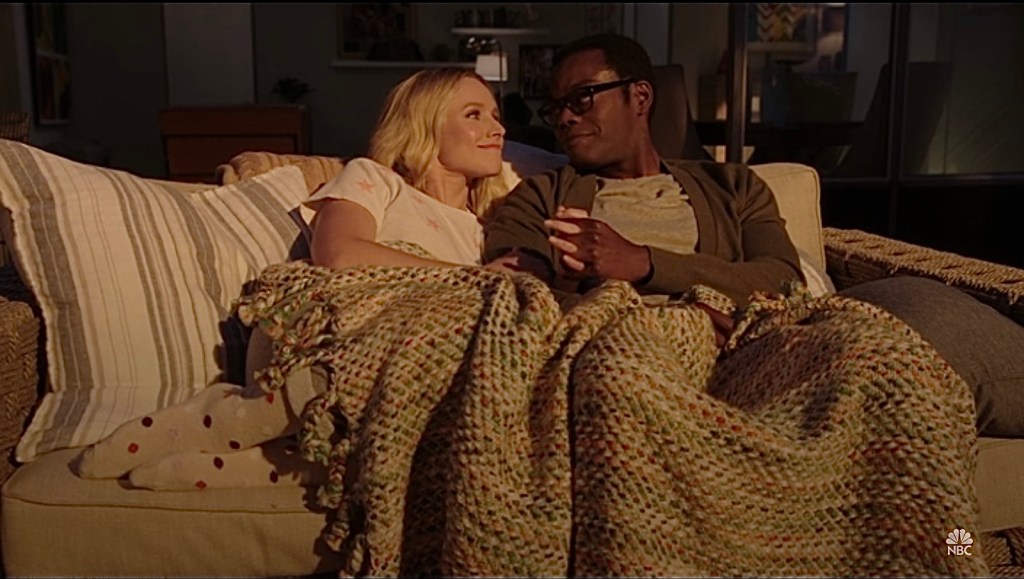
We learn lessons from various movies and shows that we watch, but we don’t often learn what feels like the lesson – or, at the very least, an eye-opening perspective on the meaning of life – and living. When Eleanor (Bell), Michael (Danson), and their friends arrive, alas, at The Good Place (the real Good Place), they find that the never-ending pleasures of the afterlife are far less gratifying than they were in mortal life. This disappointing revelation spawns yet another disappointing revelation. Infinity, they discover, diminishes everything.
“When perfection goes on forever, you become this glassy-eyed mush person,” one Good Place resident, a legendary philosopher (played by Lisa Kudrow) who can no longer remember basic mathematics, tells Eleanor and Chidi (William Jackson Harper) during an outburst of frustration, insisting she used to be cool and study “so much…things.”
“Everyone here is a happiness zombie, and no one is doing anything about it, because by the time they realize it’s happening, everyone is too far gone to care,” Eleanor tells the rest of the gang, who sigh in exasperation. The four humans in the group reached their final destination after thousands of lifetimes of ridding themselves of the qualities that had initially put them in The Bad Place, and it’s but a half hour before they stumble upon another obstacle.
But all things considered, it’s a “how did we not see this coming?” moment. Every time they were sure they were no longer selfish, narcissistic heathens, a test would prove otherwise. Every time they thought they had a challenge in the bag, they were outwitted by demons. And every time they actually won, surprise!, the reward ranged from not-so-rewardish to apocalyptic.
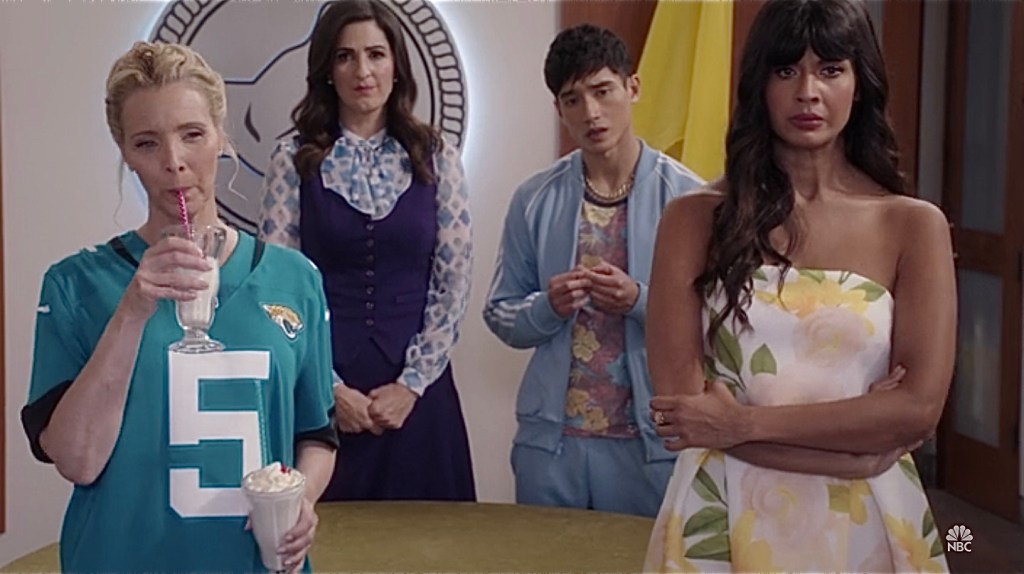
So now, they face a harsh truth. While infinite bliss appears to be the utmost paradise, the chief of all rewards that brings comfort to dying, it’s actually a sort of resting home for those with nothing left to do because doing everything got boring. Even Jason (Manny Jacinto) can only spend so much time Go-Karting with monkeys. Nobody saw that one coming, even after witnessing one of the world’s most renowned philosophers struggling to formulate a sentence.
Suddenly there’s an alternate view on living. What we too often see as a rat race of constant battles to reach endpoints and then revel in the prizes and achievements for as long as we can until it’s time to fight the next battle and then repeat repeat repeat, we forget that, without limited choices, without limited goals, and without the reminder of the limited time we took to focus on those limited choices and goals, the payoff really isn’t so great.
We see that with Tahani (Jameela Jamil) and her to-do list, where she masters every skill that there is from becoming a master woodworker to cooking something vegan that doesn’t taste vegan, not because she has a passion or even moderate interest for each skill, but because she knows time doesn’t matter where it doesn’t exist. Technically, for her, there’s no time wasted. Her bucket list isn’t narrowed down to things she wants to accomplish or experience in a mindful way that brings meaning to her as a person and therefore defines her, so the more she marks something off her list, the more dull it becomes. The exuberance of passing these barriers fades rather quickly, and soon enough, Tahani only sees emptiness ahead.
“Okay, that’s it, in a nutshell,” their new philosopher friend tells them before forgetting how to speak again. “‘Cause you get here, and you realize that anything’s possible, and you do everything, and then you’re done. But you still have infinity left. This place kills fun, and passion, and excitement, and love. Till all you have left are milkshakes.”
They conquer this dilemma, of course, and we find their solution satisfactory even if sometimes heartbreaking. These are characters we’ve grown to love, after all, and we’ve spent four seasons watching them grow to love each other and come to want to be good people, and not so they could get into The Good Place (which is what initially drove them to better themselves), but because they felt themselves changing into good people, and they liked it. They liked being good.
Even Michael, a demon who spent over a thousand years torturing people in The Bad Place and loving it, was awakened by the powerful bond of friendship after spending too much time with the humans and was spellbound by how good it felt to care about others and have others care about him too. And Janet (D’Arcy Carden), Michael’s not-at-all-human sidekick through both the bad and the good of him, had the same epiphany when she fell in love with one of the humans. She had no idea she was even capable of feeling feelings, good or bad, so this revelation brought on a bliss that she was going to fight for, every step of the way.
And she did fight. They all did. And like Eleanor says when she finally feels at peace, “You know, Michael, at the end of the day, you were right. Everything is fine.”

The lesson? Living our lives is The Good Place. We can worry about the rest later.
Watch the last five episodes at https://www.hulu.com/series/the-good-place-f11df77f-115e-4eba-8efa-264f0ff322d0
or the first three seasons at https://www.netflix.com/search?q=the%20good%20place&jbv=80113701&jbp=0&jbr=0
and the fourth and final season at https://www.nbc.com/the-good-place
 Certain Movies & Things